 Tap Baby Care
9 Weeks · 10 min read
All about your 9 week old
Wake windows lengthen, a longer night stretch becomes more plausible, and your 9 week old is becoming a real conversationalist.
Read the guideTen weeks can feel like the weather changing. Peak crying, for many babies, has begun to ease. Hands are a full-time research project. Naps still number about 4–5, but the day is more predictable if you honor 90–120 minute wake windows. You may get a baby who is fun in the morning, decent after lunch, and only moderately fussy at dusk — which, after 6 weeks, counts as a holiday.
Jump to a section
Sleep totals often sit around 13–16 hours. Wake windows of 90–120 minutes are common, with the last window sometimes a little shorter if bedtime is falling apart. Four to five naps still cover the day; a few 10 week olds start showing three longer naps plus two catnaps, which is just 5 naps wearing a costume.
Bedtime can settle into a more regular hour as the last nap ends at a similar time. If your baby is wide-eyed until 11 p.m., the fix is usually more daytime sleep or an earlier last nap, not later bedtime. Overtired late bedtimes recreate newborn chaos.
The fussy period of the first two months is declining for many families now. If nights are still a parade of 45-minute wakes, look at hunger, sleep environment, and wake-window length. Rolling practice can start to rustle the bassinet. Stop the swaddle at the first hint of rolling, even at night when it is inconvenient.
The day is more map-like: play, nap, play, nap, with fussiness often milder than at 6 weeks.
These are guidelines. What's normal and healthy can vary.
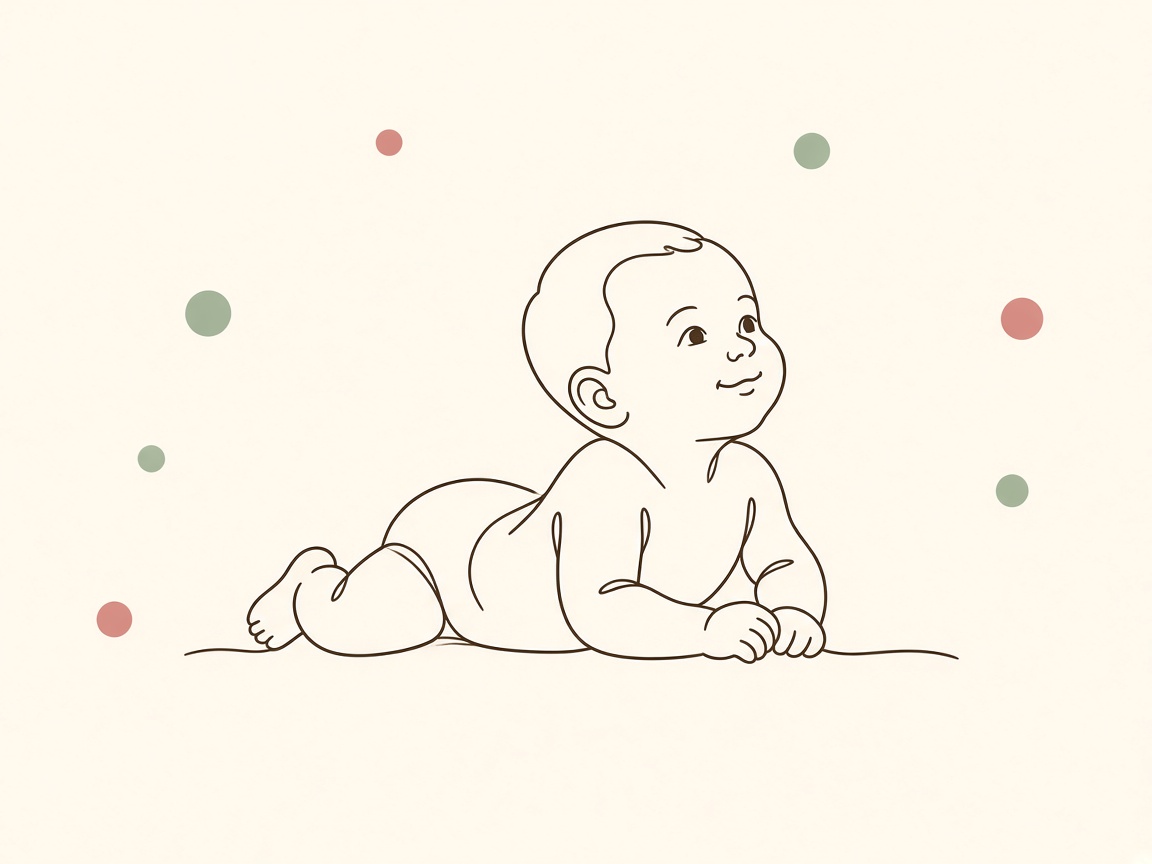
Hand discovery often peaks here: fists to mouth, hands together at midline, long stares at fingers. Batting at toys becomes a sport. In tummy time, many 10 week olds push up on forearms and look around the room, which is a huge upgrade from the newborn nose-to-mat pose. Daily tummy time of 30 minutes total is a fair aim, still in chapters.
Vocal play includes raspberries-adjacent spit sounds, longer coo strings, and fake coughs they find hilarious. They may go quiet when you enter and then explode into a smile — a pause that means recognition. Sitting with full support (your lap, a slightly reclined seat for brief awake time) lets them see the world from a new angle. Limit containers; floor time still builds the motor map.
If one side of the head is flattening or they only turn one way, mention torticollis and tummy-time variety at a visit. At 10 weeks, more awake time means more preference patterns, and those are easier to stretch now than later.
Every baby develops on their own timeline. Use this as a gentle guide. Talk to your pediatrician if you're concerned.
Many 10 week olds take about 5–6 oz, 6–8 feeds a day. Some breastfed babies settle into a 6–7 session pattern with a longer night gap. Growth spurts can still appear, but they are often shorter than the 3-week and 6-week versions. A hungrier 48 hours followed by a return to baseline is classic.
Night feeds of 1–2 are common. If your baby is back to birth weight many times over and your pediatrician is happy, you do not have to wake them for a dream feed — and you also do not have to stop a dream feed if it is buying a longer stretch for the household. It is a tool, not a moral position.
Watch for distracted feeding: a 10 week old may pop off to look at a sibling or a lamp. Feed in a slightly quieter space if intake dips. They are not bored with milk; they are interested in the world. Milk remains the only nutrition. Teething is unlikely to be the main story yet, even if people suggest it.
Download Tap Baby Care free on Google Play — one-tap logging for sleep, feeds and diapers, with AI nap windows when you need them most.
Common questions parents ask at the 10 weeks stage.
Usually 4–5. Some look like 3 “real” naps plus 1–2 catnaps. Stay flexible. The number will drift down toward 3–4 as you approach 3–4 months, not overnight this week.
Yes. Many babies move from 8–12 feeds to 6–8 as they take more per session. Diapers and weight should stay reassuring. A sudden drop in both intake and output is a reason to call.
Distractibility is a developmental upgrade. Try feeding at the start of the wake window, in a calmer space. They are not rejecting milk; they are noticing lamps.
For many babies, the worst of it fades between 8 and 12 weeks as the body clock matures. If evenings are still intense at 10 weeks, keep late-day windows conservative. If crying is inconsolable and paired with poor growth or pain signs, get a medical check.
9 Weeks · 10 min read
Wake windows lengthen, a longer night stretch becomes more plausible, and your 9 week old is becoming a real conversationalist.
Read the guide11 Weeks · 10 min read
Bedtime gets more predictable, some babies lean toward 4 naps, and forearm push-ups make tummy time look like a real sport.
Read the guideNext: All about your 11 week old — Bedtime gets more predictable, some babies lean toward 4 naps, and forearm push-ups make tummy time look like a real sport.
Read the next guide